
Join getAbstract to access the summary!
Join getAbstract to access the summary!
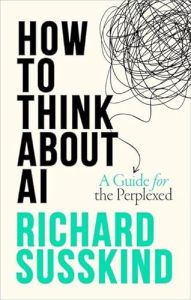
Richard Susskind
How to Think About AI
A Guide for the Perplexed
Oxford UP, 2025
What's inside?
AI is transforming the trajectory of civilization — and challenging humanity to shape what comes next.


摘要提供范围:全球
Recommendation
In this authoritative and unnerving exploration, Richard Susskind — a leading legal futurist and president of the Society for Computers and Law — delivers a sobering vision of artificial intelligence at the cusp of runaway growth. Susskind maps five possible AI-driven futures, reveals the moral, political, and existential stakes at play, and warns of outdated institutions ill-equipped to manage what’s coming. After dismantling the fallacies that distort public thought about AI, he urges humanity to think clearly — and act before the machines do.
Summary
About the Author
Richard Susskind CBE KC (Hon) holds a PhD in computers and law from Oxford. He’s president of the Society for Computers and Law, Special Envoy for Justice and AI to the Secretary-General of the Commonwealth, and a founding member of the Oxford Internet Institute. He holds professorships at Gresham College, London, and the University of Strathclyde in Glasgow, and is the author of 11 books.
By the same author
Learners who read this summary also read
What Does the AI Revolution Mean for Our Future?
How will AI impact our immediate and near future? Can the technology be controlled, and does it have agency? Watch DeepMind co-founder Mustafa Suleyman and Yuval Noah Harari debate these questions, with The Economist editor-in-chief Zanny Minton-Beddoes.
Related Skills


Comment on this summary