
Join getAbstract to access the summary!

Team Troubleshooter

Join getAbstract to access the summary!
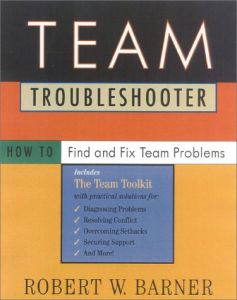
Team Troubleshooter

How to Find and Fix Team Problems

Davies-Black Publishing,

15 min read
10 take-aways
Audio & text

What's inside?

No teams are perfect, but yours can come closer than they are now.


Editorial Rating

8

getAbstract Rating

  • Applicable

Recommendation

Robert W. Barner has produced a remarkable resource. Lucid, organized, utterly practical and results-oriented, this cookbook for team builders and members belongs on every organization’s bookshelf. Barner has condensed everything he has learned from two decades of consulting and team-building experience into a five-step process for improving team relationships and performance. He identifies the most common pitfalls for teams, and provides a kit of 51 tools designed for specific team-building or team-repair tasks. Neither abstract nor psychological in nature, this practical workbook describes proven techniques and strategies for quickly and effectively addressing a wide range of problems that frequently occur among teams. Bottom line: getAbstract.com considers this an essential resource for managers, team leaders and team members.

Summary

Five Assumptions

No teams work perfectly. But if you think that diagnosing team problems is a job best left to the experts, think again. Team members and leaders are the ones most qualified to understand the types of job demands and challenges they are encountering.

Regardless of industry or work function, all teams operate within standard parameters of team dynamics and performance constraints. Understand these factors and you will be on your way to improving your team’s performance. When trying to address the shortcomings of your own teams, base your approaches on these five characteristics shared by all teams:

  1. Individuals affect team performance - New or experienced team members, outside facilitators and individuals who direct traditional work groups all have the power to influence team performance by identifying and addressing performance difficulties.
  2. Teams are their own best problem solvers - Diagnosing team problems is not a job best left to experts. Team members and leaders are best qualified to understand the problems facing them. You can use some of the tools presented in this Abstract to help reconcile team members’ ...

About the Author

Robert W. Barner, Vice President of Organizational Development and Learning for Choice Hotels International, is a 20-year veteran of international consulting. He has worked with a broad range of clients, including AT&T, Honeywell, GTE and Disney, to strengthen team performance. He is the author of Executive Resource Management, Lifeboat Strategies, and Crossing the Minefield, and his work has appeared in The Futurist, HR Magazine, and Training & Development Journal.


Comment on this summary

More on this topic

Related Skills

Be Emotionally Intelligent
Become More Productive
Communicate Effectively
Consulting Industry
Enhance Employee Experience
Executive Leadership
Foster a Culture of Innovation
Human Resources
Lead Strategically
Lead Yourself
Leadership
Live Well
Manage Learning and Development
Management
Market Insights by Industry
Navigate Leadership Challenges
Personal Growth
Plan and Strategize Your Sales
Sales
Soft Skills
Understand Innovation
Understand Organizations
Workplace Skills
Manage Change
Enhance Team Agility
Provide Feedback
Understand Personality Types
Understand Yourself
Manage Your Leadership Impact
Streamline Your Workflow
Drive Employee Engagement
Embrace Divergent Thinking
Promote Creativity
Understand Creativity
Define Roles
Drive Organizational Performance
Take Other Perspectives
Develop Self-Awareness
Manage Teams and Departments
Understand Organizational Behavior
Foster Ownership in Others
Lead Inclusively
Implement Coaching Programs
Build Team Cohesion
Understand Motivation
Ask Questions
Be Creative
Delegate Effectively
Consulting Challenges
Motivate Your Team
Ensure Accountability in Teams
Set Team Goals
Manage Team Boundaries
Make Good Decisions
Solve Problems
Challenge Assumptions
Innovation
Manage People and Talent
Lead Remote or Hybrid Teams
Facilitate Discussions
Facilitate Group Ideation
Build Psychological Safety
Take Group Decisions
Develop Team Members
Foster Team Culture
Manage Sales Teams
Collaborate Creatively
Strengthen Team Collaboration
Improve Team Performance
Understand Team Dynamics
Drive Team Performance