
Join getAbstract to access the summary!

Design AI so that it’s Fair

Join getAbstract to access the summary!

Design AI so that it’s Fair

Identify sources of inequity, de-bias training data and develop algorithms that are robust to skews in data, urge James Zou and Londa Schiebinger.

Nature,

5 min read
4 take-aways
Audio & text

What's inside?

Scientists and ethicists discuss how to mitigate gender, race and ethnic biases in AI systems.


Editorial Rating

8

getAbstract Rating

  • Analytical
  • Scientific
  • Concrete Examples

Recommendation

Identifying intrinsic biases toward gender, race and culture in artificial intelligence systems requires a structured analysis of data collection and machine learning, and of how results are parsed by humans. AI-supported decisions by government, corporations and scholars can be unintentionally tainted by such inequities. In a detailed report citing numerous real-world examples, James Zou and Londa Schiebinger offer solid suggestions about how to adjust AI algorithms, aiming for fairness to millions who may be affected. The article is required reading for anyone involved in business and policy decisions, and concerned by the ethics of AI systems.

Summary

Artificial intelligence (AI) applications tend to discriminate based on gender, ethnicity, race and income.

As AI algorithms become more sophisticated, biases creep into the design process, requiring systemic solutions. Because most AI tasks demand huge data sets, programmers must examine the gathering, organization and processing of billions of images and words. When neural networks scrape global websites such as Google Images or Wikipedia for information, unintended inequalities can occur.

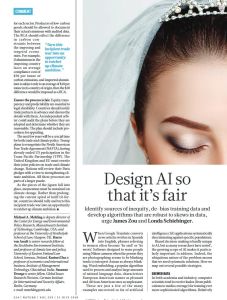
For example, India and China comprise 36% of the world’s people, but only provide about 3% of ImageNet’s 14 million pictures. This explains why its vision algorithms identify a woman in a white ...

About the Authors

James Zou is assistant professor of biomedical data science and (by courtesy) of computer science and electrical engineering, Stanford University. Londa Schiebinger is the John L. Hinds Professor of History of Science and director of Gendered Innovations in Science, Health & Medicine, Engineering, and Environment, Stanford University.


Comment on this summary

More on this topic

Related Skills

Corporate Finances
Digital Transformation
Drive AI Transformation
Enable Digital Organization
Entrepreneurship
Executive Leadership
Govern Compliance and Risk
Human Resources
Leadership
Leverage AI for Business Strategy
Leverage AI for Finance
Leverage AI for Leadership
Leverage AI for Management
Leverage AI for Product Development
Leverage AI in Your Daily Tasks
Make Good Decisions
Management
Production and Logistics
Use AI for Production & Supply Chain
Workplace Skills
Write Effective AI Prompts
Establish AI Governance
Understand AI Capabilities and Limits
Use AI for Coding and Debugging
Use AI for Feature Prioritization
Discover AI Use Cases in the Food and Beverage Industry
Drive AI Adoption in Teams
Manage Digital Risk and Ethics
Discover AI Use Cases in the Pharmaceutical Industry
AI Transformation
Use AI for Learning and Upskilling
Plan AI Workforce Transformation
Understand AI
Use AI for Candidate Screening
Discover AI Use Cases in the Finance Industry
Guide Teams Through AI Transition
Understand Agentic AI
Use AI for Compliance Monitoring
Use AI for Learning & Development
Use AI for Visual Quality Inspection
Use AI for Translation & Localization
Use AI Ethically as a Leader
Use AI for Data Analysis
Use AI for General Research
Discover AI Use Cases
Leverage AI for Compliance
Use AI for Fraud Detection
Choose AI Priorities
Discover AI Use Cases in the Public Sector
Use AI for Credit Scoring
Discover AI Use Cases in the Technology Industry
Understand AI Impact on Learning and Cognition
Use AI for Talent Sourcing
Use AI for Workforce Planning
Understand AI Risks
Use AI for Decision Support
Leverage AI for HR
Understand AI Impact on Business and Economy
Understand AI Societal Impact
Understand AI Ethical Impact
Use AI Ethically
Understand AI Impact on Work