انضم إلى getAbstract للوصول إلى الملخص!

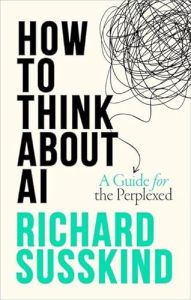
How to Think About AI

انضم إلى getAbstract للوصول إلى الملخص!

How to Think About AI

A Guide for the Perplexed

Oxford UP,

15 دقيقة قراءة
9 الوجبات السريعة
الصوت والنص

ماذا يوجد بالداخل؟

AI is transforming the trajectory of civilization — and challenging humanity to shape what comes next.

Editorial Rating

9

getAbstract Rating

  • Eye Opening
  • Hot Topic
  • Engaging

Recommendation

In this authoritative and unnerving exploration, Richard Susskind — a leading legal futurist and president of the Society for Computers and Law — delivers a sobering vision of artificial intelligence at the cusp of runaway growth. Susskind maps five possible AI-driven futures, reveals the moral, political, and existential stakes at play, and warns of outdated institutions ill-equipped to manage what’s coming. After dismantling the fallacies that distort public thought about AI, he urges humanity to think clearly — and act before the machines do.

Summary

Artificial intelligence (AI) technology isn’t new, but it’s now developing exponentially.

People imagined the advent of AI — technology that can perform tasks normally considered requiring human intelligence — as early as 1818. Functioning systems date back to the 1950s, when the pioneering computer scientist Alan Turing published a paper on the subject, “Can machines think?” The first practical AI boom came through expert systems in the 1980s, but progress stalled in the 1990s due in part to the rise of the web, which diverted focus toward more widely accessible technologies. A major leap occurred when machine learning emerged. Systems began to learn from vast data sets, enabling breakthroughs like IBM’s Watson — a system that could answer queries posed in natural language rather than code — and DeepMind’s AlphaGo — a program that bested the top human Go player in 2016.

Catalyzed by the invention of the transformer architecture and the 2022 launch of ChatGPT, new AI systems soon began to reveal capabilities that exceeded human ability. In 2024, AI scientists Demis Hassabis and John Jumper won the Nobel Prize in Chemistry after developing...

About the Author

Richard Susskind CBE KC (Hon) holds a PhD in computers and law from Oxford. He’s president of the Society for Computers and Law, Special Envoy for Justice and AI to the Secretary-General of the Commonwealth, and a founding member of the Oxford Internet Institute. He holds professorships at Gresham College, London, and the University of Strathclyde in Glasgow, and is the author of 11 books.


Comment on this summary

  • Avatar
  • Avatar
    L. W. 5 months ago
    I really love to read stuff like this.it not just produces facts that supports a particular claim but it entirely brings to light everything happening behind the scenes. <br> Come to think of it ,this incredible discovery of AI has made me have a better perception of things 'tecnologicaly' speaking. <br> I recommend this book to anyone who has interest in technology as I do.

More on this topic

Related Skills

اكتشف حالات استخدام الذكاء الاصطناعي، حدد التطبيقا
القيادة
استفد من الذكاء الاصطناعي في القيادة، دمج رؤى الذك
استفد من الذكاء الاصطناعي في الإدارة، وادمج أدوات
استفد من الذكاء الاصطناعي في مهامك اليومية، دمج أد
الإدارة
فهم الذكاء الاصطناعي، شرح المفاهيم الأساسية للذكاء
مهارات مكان العمل
إقامة حوكمة الذكاء الاصطناعي، تحديد سياسات حوكمة ا
فهم قدرات الذكاء الاصطناعي وحدوده، التعرف على قدرا
فهم تأثير الذكاء الاصطناعي على العمل، تقييم تأثير
قيادة تحول الذكاء الاصطناعي، تنفيذ تحول الذكاء الا
فهم تأثير الذكاء الاصطناعي على المجتمع، تقييم آثار
فهم الأثر الأخلاقي للذكاء الاصطناعي، التنقل في الا
استخدم الذكاء الاصطناعي لتقييم المخاطر، حدد المخاط
استخدام الذكاء الاصطناعي بشكل أخلاقي
اكتشف حالات استخدام الذكاء الاصطناعي في الخدمات ال
استخدم الذكاء الاصطناعي بشكل أخلاقي كقائد، وتجاوز
نظم للذكاء الاصطناعي، أنشئ هياكل تنظيمية تركز على
تحول الذكاء الاصطناعي، تنفيذ تحسينات العمليات المد
فهم مخاطر الذكاء الاصطناعي، تحديد عوامل خطر الذكاء