
انضم إلى getAbstract للوصول إلى الملخص!

Beyond the Algorithm

انضم إلى getAbstract للوصول إلى الملخص!
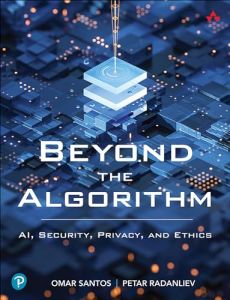
Beyond the Algorithm

AI, Security, Privacy, and Ethics

Addison-Wesley,

15 دقيقة قراءة
9 الوجبات السريعة
النص متاح

ماذا يوجد بالداخل؟

Know the uses and risks of Artificial Intelligence and Machine Learning to better handle these tools in your business.


Editorial Rating

8

getAbstract Rating

  • Applicable
  • Well Structured
  • For Beginners

Recommendation

Artificial Intelligence (AI) deploys Machine Learning (ML) to generate algorithms and statistical models used in a variety of fields, including healthcare, finance, transportation, communications, and the energy sector. But, as AI security experts Omar Santos and Petar Radanliev argue, the rise of AI also brings moral challenges. It can open companies up to a number of legal and security risks, including cyberattacks. By offering a non-technical overview of AI’s uses and raising awareness of AI-related vulnerabilities, Santos and Radanliev empower readers to tackle related challenges head-on.

Summary

People have speculated about the possibility of Artificial Intelligence (AI) for centuries.

People have imagined creating intelligent machines since ancient times. Greek myths featured mechanical creatures capable of independent thought. The great 17th-century philosopher René Descartes theorized that the human mind was machine-like and posited that mathematics might be able to explain its functions. The first real advances in artificial intelligence came during the Second World War when British mathematician and cryptographer Alan Turing developed his Turing machine. But it wasn’t until the legendary 1956 Dartmouth College “Dartmouth Conference,” which included AI founders like Alan Turing, Marvin Minsky, and Herbert A. Simon, that AI became a real research field. Then the 1960s and 1970s saw significant advances in “expert systems” capable of human-like analysis.

AI leverages Machine Learning (ML) to analyze data, make predictions, and automate tasks.

People refer to the AI systems and tools that exist today as “narrow” AI. This form of AI performs specific tasks — like image recognition or natural language...

About the Authors

Omar Santos is an expert in ethical hacking, vulnerability research, incident response, and AI security. He is the author of numerous books and video courses. Petar Radanliev completed his PhD at the University of Wales and became a Post-Doctoral Research Associate in the Department of Computer Science at the University of Oxford.


Comment on this summary

More on this topic

Related Skills

تحول الذكاء الاصطناعي، تنفيذ تحسينات العمليات المد
قيادة تحول الذكاء الاصطناعي، تنفيذ تحول الذكاء الا
الموارد البشرية
القيادة
استفد من الذكاء الاصطناعي في الموارد البشرية، وادم
استفد من الذكاء الاصطناعي في القيادة، دمج رؤى الذك
استفد من الذكاء الاصطناعي في مهامك اليومية، دمج أد
فهم الذكاء الاصطناعي، شرح المفاهيم الأساسية للذكاء
مهارات مكان العمل
استخدم الذكاء الاصطناعي في التعلم والتطوير، دمج أد
فهم الذكاء الاصطناعي التوليدي، تحديد فرص الذكاء ال
فهم تأثير الذكاء الاصطناعي على العمل، تقييم تأثير
استخدم الذكاء الاصطناعي لإدارة الثغرات، دمج الذكاء
استخدم الذكاء الاصطناعي بأمان، تأكد من الامتثال لأ
فهم مخاطر الذكاء الاصطناعي، تحديد عوامل خطر الذكاء
استفد من الذكاء الاصطناعي في الأمن السيبراني، حدد
استخدم الذكاء الاصطناعي لتحليل البيانات، نفذ الذكا
فهم نماذج اللغة الكبيرة، تحليل فوائد نماذج اللغة ا
استخدم الذكاء الاصطناعي بشكل أخلاقي كقائد، وتجاوز
فهم تأثير الذكاء الاصطناعي على المجتمع، تقييم آثار
استخدام الذكاء الاصطناعي بشكل أخلاقي
فهم الأثر الأخلاقي للذكاء الاصطناعي، التنقل في الا